
Last updated October 16, 2026
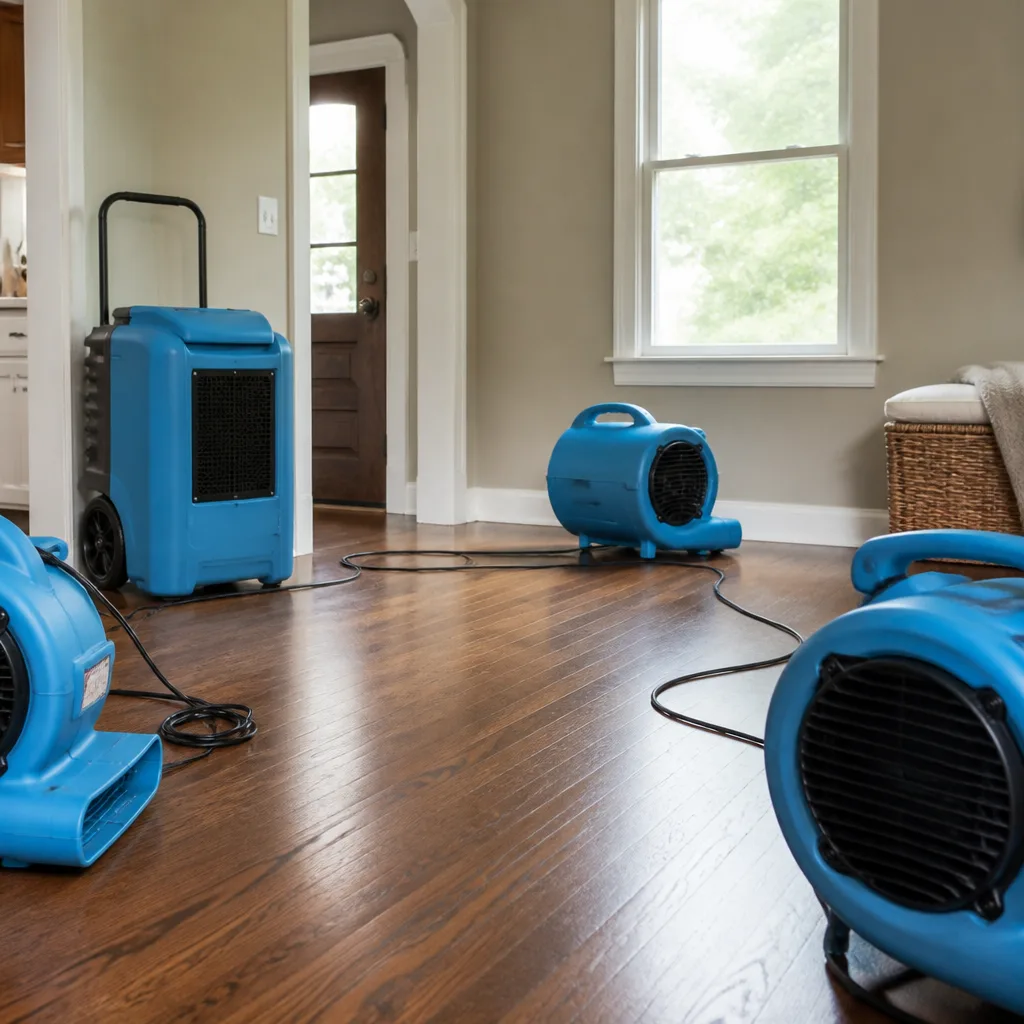 Water damage drying
 Fire & smoke cleanup
 Mold remediation
 Storm response
 Sewage cleanup
 Reconstruction
Free visual inspection and a written scope of work before any mitigation begins - photos, moisture readings, and drying logs go in your claim file
The scope we write is the scope we bill. Anything new gets shown to you, in writing, before we touch it.
Get your free estimateHow to Hire a Damage Restoration Contractor in Jacksonville: A Step-by-Step Guide
Florida does not require a specialty license to perform water or mold mitigation work. Only certain structural repairs require a contractor’s license. That legal gap means a homeowner in Jacksonville can hand a house key to someone with zero state oversight, no verified training, and no insurance that would cover a botched drying job or a stolen television. This guide closes that gap for you, and our complete guide to damage restoration in Jacksonville offers deeper background. You’ll learn the exact license numbers to verify, the contract clauses that protect your money, the insurance documents to demand before any crew enters your home, and the red flags that expose storm chasers and assignment-of-benefits operators before they do damage that outlasts the original water.
Restoration work we handle
Quick Answer
To hire a damage restoration contractor in Jacksonville, verify the company’s license on the Florida DBPR portal, confirm IICRC certification for water or mold work, demand proof of general liability and workers’ compensation insurance, refuse to sign any contract without a written scope of loss and moisture assessment, and reject any verbal warranty or assignment-of-benefits agreement. A legitimate contractor in Jacksonville puts the price in writing before work starts, documents every step of the job, and stands behind the repair for at least a year.
Table of Contents
- The Licensing Gap That Lets Unqualified Contractors Into Jacksonville Homes
- Step 1: Verify the License Before You Hand Over a Key
- Step 2: Understand What IICRC Certification Actually Means
- Step 3: Check the Insurance Documents Most Homeowners Skip
- Step 4: Demand a Moisture Assessment Before Any Price Quote
- Step 5: Read the Contract for the Five Clauses That Decide Everything
- Step 6: Spot Jacksonville Storm Chasers and AOB Pressure Tactics
- Step 7: Ask the Guarantee Question Contractors Hope You’ll Skip
- Common Mistakes to Avoid
- When to Call a Professional
- Frequently Asked Questions
- The Bottom Line
The Licensing Gap That Lets Unqualified Contractors Into Jacksonville Homes
Most homeowners assume anyone who advertises water damage restoration, fire damage restoration, or mold remediation carries some kind of state license. That assumption is expensive. Florida’s Department of Business and Professional Regulation (DBPR) licenses general contractors, building contractors, and residential contractors. But it does not offer a “water mitigation license” or a “mold remediation license” at the state level. A company can legally perform extraction, drying, demolition, and mold removal in Jacksonville without holding any DBPR contractor license at all, as long as the work stops short of structural repair.
This matters because the actual work of restoration involves more than moving air. A proper water damage job includes psychrometrics, the science of measuring moisture in air and materials, to confirm a structure is dry, not just dry-feeling. It requires understanding how water moves through drywall, subfloor, and sill plates in Jacksonville’s humidity-heavy climate. A tech who skipped that training may leave the site with a clean-looking wall and a moisture level behind it that feeds mold for months. We’ve walked into homes in Riverside and Mandarin where a previous contractor’s drying job failed within weeks because no one took moisture readings behind the baseboards.
What the state won’t verify, you must. The gap is the strongest argument for doing your own credential check before signing anything. It also explains why the contract terms matter more in Florida restoration work than in almost any other home repair.
Step 1: Verify the License Before You Hand Over a Key
The first screening question is simple: “What’s your Florida DBPR license number?” A legitimate water damage restoration contractor in Jacksonville who performs structural repairs will carry a general contractor (CGC) or building contractor (CBC) license issued by the Florida Department of Business and Professional Regulation. Some also hold a residential contractor (CRC) license. The number format starts with the license type code, so “CGC1528XXX” tells you the company holds a certified general contractor license.
Here’s the verification sequence we recommend to every Jacksonville homeowner:
- Ask for the license number in writing. If the contractor hesitates, stumbles, or says “we don’t need one for this kind of work,” that’s a signal, not an automatic disqualification. Some mitigation-only companies operate legally without a DBPR contractor license. But you now know the limitation: they cannot legally perform structural repairs. Ask what happens when the job requires one.
- Look it up on the Florida DBPR portal. Go to myfloridalicense.com and search the license number. Confirm the name on the license matches the company name on the contract. Discrepancies are common with subcontractors.
- Check the status. The license must show “Current, Active.” Any other status is a hard stop.
- Ask about IICRC credentials separately. The IICRC (Institute of Inspection, Cleaning and Restoration Certification) issues water damage restoration (WRT) and applied structural drying (ASD) certifications, but the state does not require them. Many of the best mitigation crews in Jacksonville carry those certs; many of the worst do not.
For mold remediation in Jacksonville, ask whether the company follows the IICRC S520 standard and whether the assessor who wrote the mold protocol is independent from the company doing the removal. In our experience, that independence question separates ethical operators from those who conveniently find mold everywhere they look.
Step 2: Understand What IICRC Certification Actually Means
IICRC certification is the strongest available signal of training in the restoration trade, which is why Keegan technicians train to IICRC standards. But the certification itself deserves a clear-eyed explanation, because contractors use the letters to imply more than they guarantee.
The IICRC is a non-governmental standards and certification body. A technician who holds WRT certification has passed a course and exam on the science of water damage, including extraction techniques, drying theory, and moisture measurement. An ASD certification goes deeper into psychrometrics, drying chamber setup, and monitoring. A company that lists RIA (Restoration Industry Association) or IFA (International Fireproofing Association) standards is signaling that it follows industry consensus practices, not state law.
What the certification does not do:
- It does not license the company. A certified technician working for an unlicensed company still does not allow that company to perform structural repairs requiring a DBPR license.
- It does not guarantee ethical business practices. A certified tech can still run a crew that moves the price at the door.
- It does not imply insurance coverage. Certification and liability insurance are separate questions.
- It does not promise a warranty. Some certified techs offer no written guarantee at all.
Treat IICRC certification as a baseline expectation for the person holding the moisture meter, not as a substitute for the other six steps in this guide. We run our jobs to standards set by IICRC, RIA, and IFA, and every technician who enters a Jacksonville home carries identification and arrives in uniform. The letters matter. The contract matters more.
Step 3: Check the Insurance Documents Most Homeowners Skip
The single most important piece of paper you will collect, after the contract itself, is the certificate of liability insurance. A professional restoration company in Jacksonville can produce this within hours. A storm chaser will stammer and produce a fake or nothing.
What a legitimate certificate of liability should list:
- Named insured: This must match the company name on the contract and the license, not some other entity.
- General liability coverage: Industry practice for restoration work is $1 million per occurrence and $2 million aggregate. If the certificate shows $100,000 or $300,000, that is a handyman policy, not a restoration policy.
- Workers’ compensation coverage: This is non-negotiable when crews work inside an occupied home. If an uninsured worker is injured on your property, Florida law leaves the homeowner exposed in ways most people do not discover until after the injury. A professional company carries workers’ comp on every employee and can prove it.
- Additional insured language: Ask the company to list you, the homeowner, as an additional insured for the duration of the job. Companies that resist this request are revealing how they handle accountability.
- Policy dates: The coverage must be active on the day work begins, not expired last month.
Restoration work in Jacksonville involves water extraction equipment, air movers from brands like XPOWER and B-Air, and occasionally injection drying systems from Injectidry. It is industrial work performed inside your living room. The insurance questions are not paperwork theater. They are the only barrier between you and a lawsuit if the job goes wrong.
Step 4: Demand a Moisture Assessment Before Any Price Quote
Here’s a scene we’ve seen too often in Jacksonville: a contractor arrives, walks through the house, taps a wall, and announces, “Full dry-out plus repair, $8,400.” The homeowner signs. The crew works for a day. Then the contractor discovers “unexpected damage” and the price climbs.
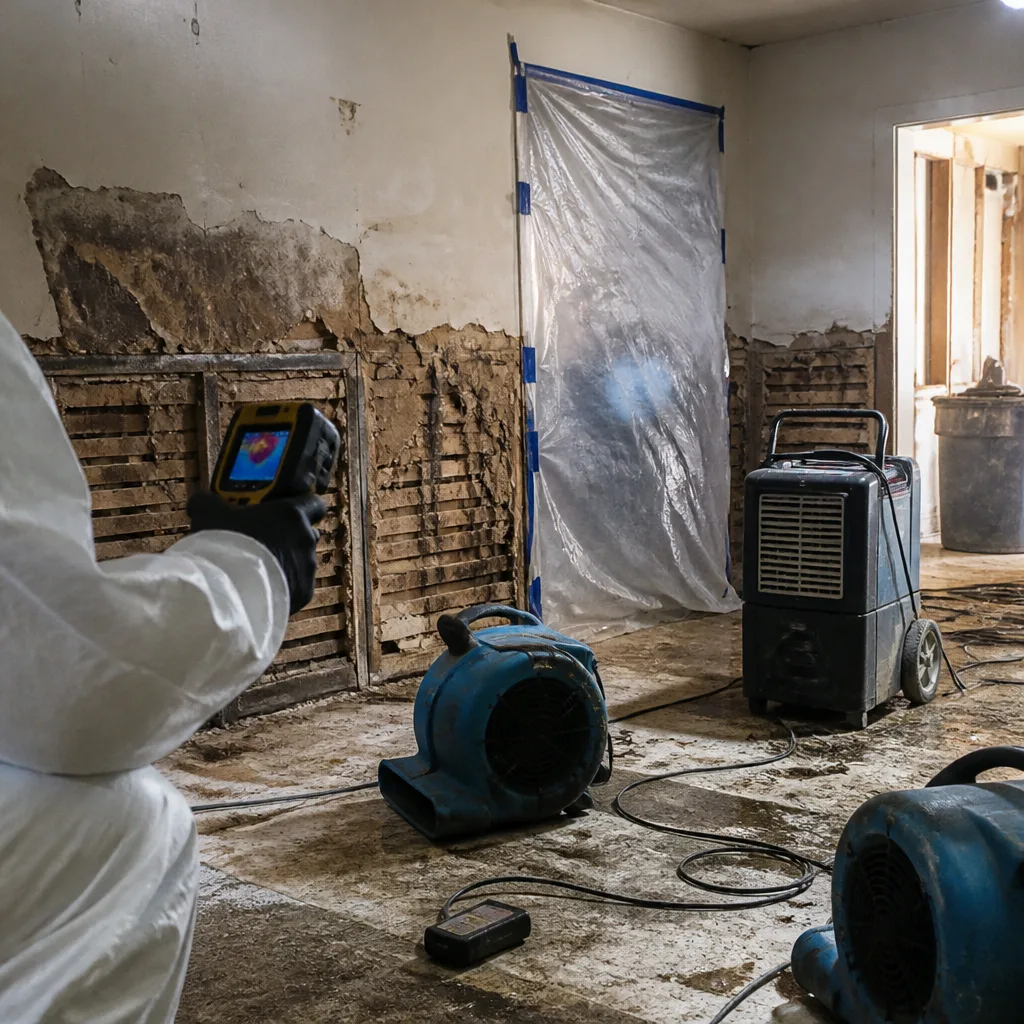
That sequence happens because the contractor never took a moisture reading. A legitimate restoration company will not quote a final price until it completes a moisture assessment that maps the affected area with real instruments. The assessment identifies where water traveled behind walls, under flooring, and into building cavities. Only after that mapping is done can anyone write a scope of loss that holds up.
Every contractor who quotes a final price before completing a moisture assessment and written scope is structuring the job to move the number later. Here’s how a proper assessment runs:
- Visual inspection of the source and visible damage.
- Moisture mapping with penetrating and non-penetrating meters to find hidden water.
- Thermal imaging where needed to identify cooler, wetter areas behind walls and ceilings.
- Drying plan with the target moisture levels, the number of air movers and dehumidifiers required, and a monitoring schedule.
- Written scope of loss that lists every affected area, the planned mitigation work, and the price.
At Keegan, that written scope is the contract. The price is put in writing before any work begins, every time, on every job. That policy exists because it is the only way a homeowner can make a rational decision about how much of the job the insurance company will pay and how much is out of pocket.
Step 5: Read the Contract for the Five Clauses That Decide Everything
Florida restoration contracts are not uniform. Two identical-looking jobs can carry radically different legal exposure depending on five clauses buried in the fine print. Read for these before you sign.
Three clauses that protect you:
- Fixed scope with written change-order requirement. The contract should state that any additional work beyond the written scope requires a signed change order before the work is performed, and the change order must show the new price. This clause alone prevents the most common form of price escalation.
- Completion standard tied to IICRC or comparable industry standards. The contract should define “done” as reaching drying goals verified by moisture readings, not “the equipment ran for three days.” Without a completion standard, the contractor decides when the job is finished, and that decision tends to align with the next job waiting across town.
- Warranty in writing. The guarantee must be a written clause, not a verbal promise. The Keegan restoration process in Jacksonville includes a 365-Day Done Right Promise: if the repair fails within one year, we return and make it right at no charge, with a free second visit. A contractor who will not put a guarantee in writing has told you everything you need to know.
Two clauses that waive your rights:
- Binding arbitration with the contractor’s chosen arbitrator. This clause strips your right to sue in court and sends disputes to a private process the contractor controls. Some arbitration clauses are so one-sided they include a confidentiality requirement, which prevents you from warning other Jacksonville homeowners.
- Lien waiver signed at the start, not the end. A mechanic’s lien waiver is normal at final payment. A waiver demanded before work begins is a red flag. It signals the contractor expects payment disputes and wants to limit your leverage before the first air mover is plugged in.
Step 6: Spot Jacksonville Storm Chasers and AOB Pressure Tactics
Jacksonville has a particular vulnerability: hurricane season. Our Seasonal Damage Restoration Care for Jacksonville: Year-Round Homeowner’s Guide breaks down what to watch for. Every named storm that brushes Duval County brings a caravan of out-of-state “restoration companies” that set up in hotel parking lots and work through a neighborhood list. The storm chaser playbook is consistent, and once you know it, it is easy to spot.
The storm chaser red flags:
- Canvassing door-to-door within days of a storm. Legitimate Jacksonville restoration companies have local phone numbers, local addresses, and local referrals. Storm chasers carry magnetic door signs and phone numbers that route to a call center in another state.
- No local references. Ask for the addresses of three recent Jacksonville jobs. A legitimate local contractor can supply them. A storm chaser cannot.
- Assignment-of-benefits pressure. An AOB is a legal document that transfers your insurance claim rights to the contractor. Once signed, the contractor can bill your insurer directly, inflate the claim, and sue the insurer if the claim is denied, all without your consent. Florida law has tightened AOB rules, but the pressure tactic persists. A reputable contractor will work with your insurer as your advocate, not demand you sign away your rights. At Keegan, we document every job and format the records to support your insurance claim, and we coordinate with adjusters directly. We never ask you to sign an AOB.
- Verbal-only warranties. “We guarantee our work for five years” means nothing if it is not in writing. Storm chasers know they will be gone before any warranty claim arises.
- No certificate of liability produced on request. Chasers may not even carry Florida workers’ comp. That exposure lands on you.
Jacksonville’s climate adds another layer. The high humidity means a poor drying job will not just fail cosmetically; it will support mold growth within days. A contractor who does not understand the relationship between fire damage restoration in Jacksonville and the humidity that complicates it, or the way water migrates through the region’s slab-on-grade construction, is not equipped for the job no matter how good the sales pitch.
Step 7: Ask the Guarantee Question Contractors Hope You’ll Skip
“What exactly does your guarantee cover, and for how long?” is the highest-value question in the entire hiring conversation. Most contractors answer vaguely: “Oh, we stand behind our work.” Push further. The answer reveals the business model.
A real guarantee specifies three things:
- What is covered. The repair itself? The materials? The workmanship? A guarantee that covers only labor is not worth much when the failed part is a floorboard.
- How long it lasts. Thirty days is not a guarantee; it is an inspection window. Industry minimum for reputable restoration work is one year. Keegan’s 365-Day Done Right Promise is a written, one-year guarantee on every repair, with a free return visit if the work fails within that period.
- What happens when it fails. Does the contractor return? At whose cost? Within what timeframe? A guarantee with no enforcement mechanism is a marketing slogan.
The Garrison Standard governs every Keegan job: show up inside the window, price in writing, do it by the book, leave the site clean, stand behind the work for a full year. That standard is not a sales pitch; it is the operating manual. If the contractor you’re interviewing cannot articulate a comparable standard in one sentence, keep looking.
Common Mistakes to Avoid
- Hiring the first contractor who answers the phone. When water is spreading, speed feels like the priority. But a rush hire is exactly what storm chasers count on. Take thirty minutes to run the license check and insurance verification before signing.
- Accepting a price quote without a moisture assessment. We covered this above, but it bears repeating: no moisture map, no price. A contractor who quotes blind will bill blind.
- Signing an assignment-of-benefits agreement because the contractor says it’s standard. It is not. A Jacksonville homeowner should never transfer claim rights to a contractor they just met.
- Assuming the homeowner’s insurance covers the contractor’s mistakes. It generally does not, at least not without a drawn-out fight. That is what the contractor’s liability insurance is for, and it is why you verified it in Step 3.
- Believing a verbal warranty. In Florida’s heat and humidity, repairs fail more often than homeowners expect. A written guarantee is the only guarantee.
- Ignoring the completion standard. If the contract says “job complete when equipment is removed” without any reference to moisture readings, you have signed a contract where the contractor’s convenience, not the condition of your home, determines the finish line.
- Skipping the “who does the work” question. Ask whether the crew is composed of background-checked employees or day laborers picked up that morning. The answer matters when those people are inside your home alone.
When to Call a Professional
Some situations tolerate a homeowner attempting a fix with a shop vac and a fan. Others do not. Call a professional immediately when: water has penetrated walls or subflooring; the water source is sewage or floodwater; electrical outlets or wiring have been contacted; the water has sat for more than 24 hours; you smell mold or see discoloration spreading; or a fire has left behind smoke residue inside ductwork. These situations require professional-grade drying equipment and a documented scope of loss to protect your insurance claim. Keegan Restoration Jacksonville offers free estimates in Jacksonville, and a live person answers every call, 24 hours a day. Reach us at (904) 664-5108.
Frequently Asked Questions
Water damage restoration in Jacksonville typically costs between $1,200 and $4,500 for moderate, single-room mitigation, with full structural drying and repair running $8,000 to $20,000 depending on the affected square footage, water category, and duration of exposure. The price depends heavily on whether the contractor completes a proper moisture assessment before quoting. For a step-by-step breakdown, see our Water Damage Restoration Maintenance Checklist for Jacksonville Homeowners. Call (904) 664-5108 for a free estimate based on your specific situation.
Florida does not require a specialty license for water mitigation or mold remediation work. Structural repairs may require a DBPR contractor license, but the mitigation itself operates in an unlicensed gap. That is why verifying IICRC certification, insurance coverage, and the written contract terms is essential for Jacksonville homeowners.
Most Jacksonville homeowner policies cover sudden and accidental water damage, such as a burst pipe or storm-related intrusion, but exclude gradual leaks, flooding from rising water, and neglect. The restoration company’s documentation, including moisture readings and photo evidence, often determines how the adjuster processes the claim. Keegan formats every job record to support your insurance claim and coordinates with adjusters directly.
A professional restoration company in Jacksonville can typically have a crew on site within hours of your call, not days. Water damage compounds quickly in Florida’s climate; mold can begin growing within 24 to 48 hours. Keegan answers every call with a live person, 24/7, and dispatches background-checked technicians who arrive in uniform.
Mitigation is the emergency work: extraction, drying, dehumidification, and preventing further damage. Repair is the reconstruction: replacing drywall, flooring, and fixtures after the structure is dry. Many Jacksonville contractors do one or the other. Keegan handles both, from the first extraction to the final walkthrough, all under the 365-Day Done Right Promise.
If mold covers more than 10 square feet, if it has penetrated porous materials like drywall or carpet, or if it follows a water event that saturated building cavities, a surface cleaning will not solve the problem. Mold grows behind walls and under floors where cleaning cannot reach. Professional mold remediation in Jacksonville requires containment, air filtration, and source removal, not just surface treatment. A free assessment at (904) 664-5108 will clarify which situation you have.
The Bottom Line
Hiring a damage restoration contractor in Jacksonville is a decision made under pressure, which is exactly why the process matters more, not less, than other home repairs. For more guides & resources on protecting your home, explore our blog. Florida’s licensing gap means the responsibility for verification falls on you. The sequence is straightforward: verify the DBPR license, confirm IICRC credentials, demand proof of liability and workers’ comp coverage, insist on a moisture assessment before any quote, read the contract for the five clauses outlined above, reject storm chaser tactics, and get the guarantee in writing. A contractor who passes every step will be able to show you the paperwork without hesitation. That is the contractor you let inside your home. Keegan Restoration Jacksonville has been part of the Garrison Partners family since 2005, and every job runs to The Garrison Standard: written price before work starts, background-checked uniformed technicians, and a 365-Day Done Right Promise in writing. Call (904) 664-5108 for a free estimate.
Written by Shane Pruitt, Owner at Keegan Restoration Jacksonville, serving Jacksonville since 2005.
See the difference
 Before
 After
After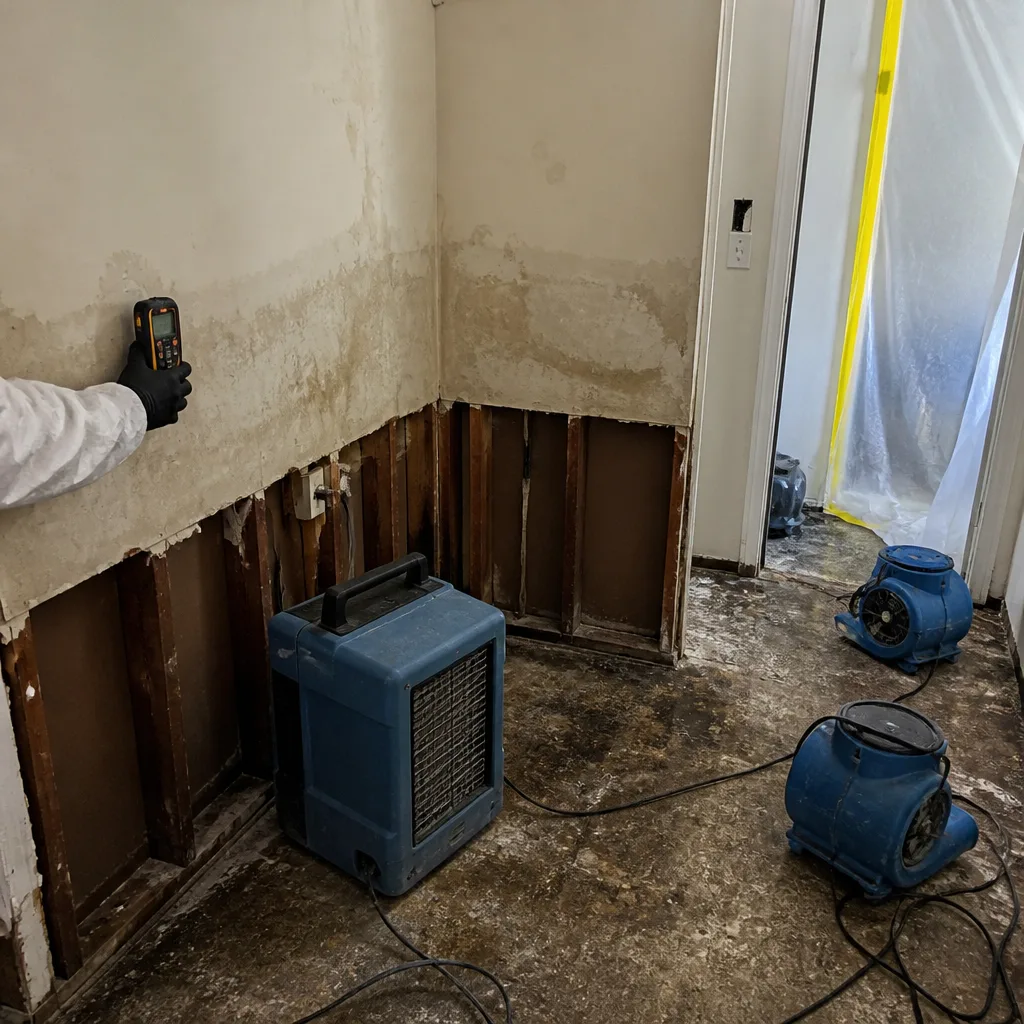 Before
 After
After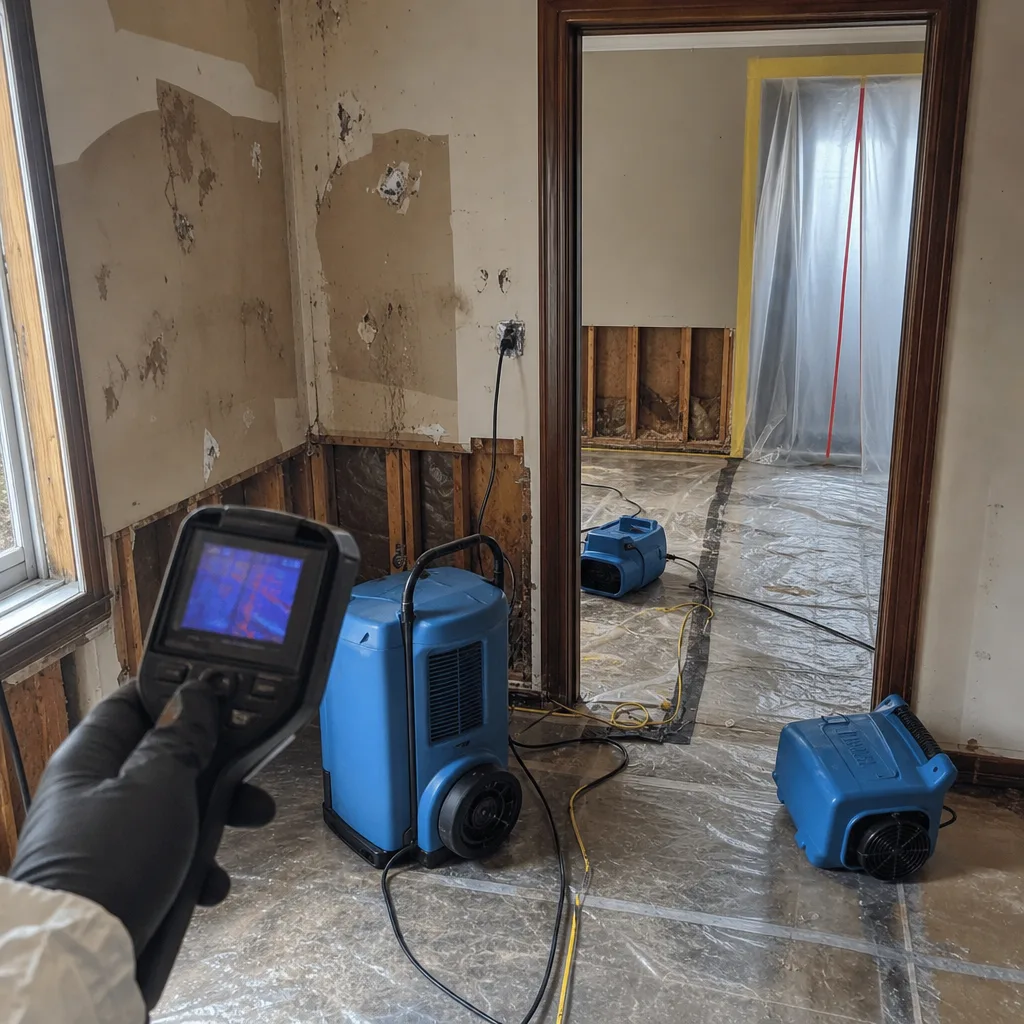 Before
 After
After