
Last updated October 16, 2026
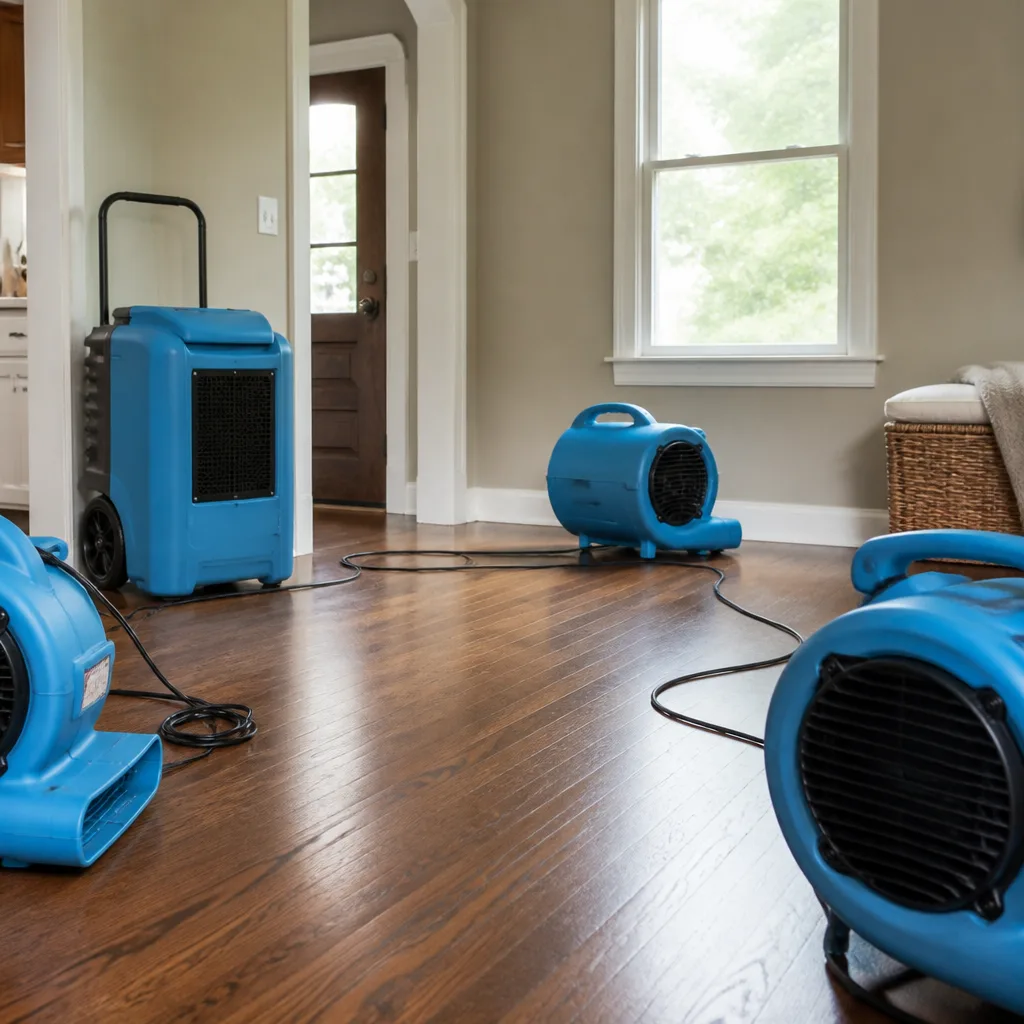 Water damage drying
 Fire & smoke cleanup
 Mold remediation
 Storm response
 Sewage cleanup
 Reconstruction
Free visual inspection and a written scope of work before any mitigation begins - photos, moisture readings, and drying logs go in your claim file
The scope we write is the scope we bill. Anything new gets shown to you, in writing, before we touch it.
Get your free estimateWater Damage Restoration Maintenance Checklist for Jacksonville Homeowners
Jacksonville’s subtropical climate creates a water damage equation that national home-maintenance advice simply doesn’t account for. We run over 120 days of 80-plus-degree heat, and during summer, Gulf moisture feeds afternoon thunderstorms that can drop two inches on a single neighborhood while the one next door stays dry. The three conditions behind most preventable water damage calls in Jacksonville’s 32207 and 32210 zip codes are all detectable with a flashlight and 20 minutes: a roof-to-soffit transition that’s quietly delaminating, a condensate line that’s been clogged since March, and a slope around the slab that’s been settling the wrong direction for years. We built this checklist around those failure points because we’ve seen them on job after job. This guide gives you a calendar-tied inspection system you can hand to an adjuster as proof you did the work, not just thought about it.
Restoration work we handle
Quick Answer
A water damage prevention checklist for Jacksonville homeowners should run on a seasonal schedule: inspect roof-to-soffit transitions and flashing before hurricane season, flush the HVAC condensate line monthly during the 12-month cooling season, verify slab-adjacent grading at a 6-inch drop over 10 feet twice a year, and test a moisture baseline on interior drywall with a $30 meter quarterly. Document every check in a dated log so you have a written maintenance record if you ever file a claim. Most damaging Jacksonville water intrusion starts small and detectable; the checklist below tells you exactly what to look for and when.
Table of Contents
- Jacksonville’s Seasonal Maintenance Calendar
- The Roof-to-Soffit Transition Check Every Jacksonville Ranch Needs
- How to Test and Interpret Your Home’s Moisture Baseline
- Irrigation and French Drain Grading Checks for Jacksonville’s Flat Lots
- HVAC Condensate Line Maintenance for a 12-Month Cooling Season
- Your Written Maintenance Log: What to Record and Why It Matters for Insurance
- Common Mistakes to Avoid
- When to Call a Professional
- Frequently Asked Questions
- The Bottom Line
Jacksonville’s Seasonal Maintenance Calendar
Jacksonville doesn’t have four seasons in the traditional sense. You have a long hot wet stretch that runs from May through October, a short mild stretch into the holidays, and a February-to-April window where pollen coats everything and showers come in unpredictable bands. The maintenance calendar below follows that rhythm. If you do nothing else on this page, do the two items marked before June 1. Those two checks catch the conditions behind most of the Water Damage Restoration services we run between July and September.
Here is the calendar, built around the actual weather Jacksonville gets, not a generic temperate-climate template (see also our The Complete Guide to Damage Restoration in Jacksonville):
January to March
- Test interior moisture baseline on all exterior-facing walls with a moisture meter. Record readings in your log.
- Inspect every supply line under sinks, behind toilets, and at the water heater for corrosion, slow drips, or mineral crust at the fittings.
- Walk the yard after a heavy rain and mark any place where water stands for more than 1 hour against the slab or foundation wall.
- Open the HVAC air handler and check the condensate pan for standing water. If water sits, the drain line is already started to clog.
April to May
- Inspect the roof-to-soffit transition (detailed below). This is the pre-hurricane-season check you cannot skip.
- Verify slab-adjacent grading slopes away at the 6-inch-in-10-feet measurement described in the grading section.
- Test your main water shutoff valve. Turn it, count the turns, and confirm it seats fully closed. A shutoff that won’t close turns a burst pipe into a full floor-loss.
- Check washing machine hoses and refrigerator supply lines. If the hoses are rubber and older than 5 years, replace with braided stainless.
June to October
- Flush the condensate drain line the first weekend of every month. Jacksonville’s cooling season runs year-round in most homes, but these five months produce the heaviest condensate volume.
- After any storm that drops more than 2 inches in 24 hours, check the attic for damp spots on the underside of the roof deck.
- Verify gutters and downspouts are clear. A downspout that dumps water at the foundation corner during a 3-inch storm undoes years of good grading.
November to December
- Repeat the interior moisture baseline check and compare against first-quarter readings. Any wall showing a 5% or higher jump from baseline gets investigated.
- Inspect exterior hose bibs and any outdoor plumbing for hairline cracks or weeping seals after the first cold snap.
The Roof-to-Soffit Transition Check Every Jacksonville Ranch Needs
Jacksonville’s housing stock includes tens of thousands of ranch-style homes built between 1950 and 1985. These homes share a specific failure point: the transition where the roof deck meets the soffit at the eaves. Water runs down the roof, follows the drip edge, and if that transition has even a small gap, the water rides back under the shingles and into the soffit cavity. From there it travels along the top plate of the exterior wall and shows up as a mystery stain on an interior ceiling three feet inside the house. We see this exact pattern in Riverside, Murray Hill, and San Marco every year.
Here is the 20-minute inspection, in order:
- Stand back from each corner of the house and look at the fascia line. It should run straight. Any wave, dip, or sag means the underlying soffit board has already taken on water and started to soften.
- Look at the underside of the eaves from a ladder or from the ground with binoculars. You’re looking for dark spots, water trails, peeling paint in a line, or any place where the soffit board has pulled away from the fascia.
- At each inside corner where a gutter runs along the roof, look for a gap between the shingle edge and the drip edge. In an aging Jacksonville ranch, shingles shrink. A gap of even 3/8 inch opens the transition to wind-driven rain, which Jacksonville gets with every summer thunderstorm.
- Push gently on the soffit surface in two or three places with a screwdriver handle. Sound wood gives a solid tap. Softened wood gives a dull thud and may show a slight depression. If it thuds, the transition has been failing for months, not weeks.
- Check the attic directly above the top plate of every exterior wall. In a ranch, this often means crawling to the extreme edges. Look for dark staining on the top plate itself or on the underside of the roof decking adjacent to the eaves.
One more thing about Jacksonville specifically: our summer storms drive rain almost horizontally. A standard 1-inch drip edge is not enough on the windward side of many homes. If your home faces east or southeast and you’ve already had one soffit repair, consider a 2-inch drip edge on that elevation. The cost difference is small; the water kept out is not.
How to Test and Interpret Your Home’s Moisture Baseline
A moisture baseline is simply the reading your drywall gives under normal conditions. Once you know what normal looks like in your house, you can catch water intrusion weeks before it becomes a visible stain. In Jacksonville’s humid climate, lumber and drywall carry more ambient moisture than in, say, Phoenix. That means national “normal” numbers don’t quite transfer. Jacksonville interior walls in a conditioned space should read between 5% and 12% on a standard pin-type moisture meter. Exterior-facing walls after several days of rain may read up to 15% at the bottom plate without indicating a leak. A reading above 17% on an interior wall, or a jump of more than 5 percentage points from your own recorded baseline on the same wall, means water is getting in from somewhere.
Here is how to set and use a baseline:
- Buy a basic pin-type moisture meter. A $30 to $50 meter from General or Klein is plenty for homeowner use. You don’t need the $400 professional meter our techs use with Dri-Eaz and Phoenix equipment; you need something that gives you a consistent number.
- Pick eight test points: two on each side of the house, at waist height and at the baseboard, on both exterior and interior walls.
- Record the reading at each point on a dry afternoon in March. Do it again on a dry afternoon in November. Average each wall’s two readings. That’s your baseline.
- Test the same eight points quarterly. Any point reading 5 points or more above its baseline means water has entered the wall cavity recently. Call a pro before you see a stain.
- If your meter spikes at a baseboard but the wall above reads normal, check the slab edge and bottom plate in that area first. That pattern almost always means moisture wicking up from a slab-sidewater source, not a roof or plumbing leak.
We run professional-grade moisture logging equipment on every water damage restoration job in Jacksonville, in line with the standards set by the Restoration Industry Association and the Institute of Inspection, Cleaning and Restoration Certification. Your $30 meter won’t match that level of data resolution. What it will do is tell you when it’s time to call before the damage spreads.
Irrigation and French Drain Grading Checks for Jacksonville’s Flat Lots
Jacksonville is built on flat land. The elevation difference from the St. Johns River to five miles inland is often less than 20 feet. That flatness means gravity drainage works slowly at best, and at worst, not at all. When a lot has been regraded after construction, or when an irrigation system has run for a decade, the slope around a slab can actually reverse. Water that used to drain away now pools against the foundation. The soil expands with the wet season, contracts when it dries, and the pressure cycle slowly works on the slab edge, footings, and any crack that has already formed.
The slope measurement that matters: you want at least a 6-inch drop in elevation across the first 10 feet of soil starting from the slab edge. That is a 5% grade. Less than that, and heavy summer rain won’t move away fast enough. Here is how to check it:
- Drive a stake into the soil directly at the slab edge. Tie a string to it at ground level.
- Walk the string out 10 feet perpendicular from the house. Drive a second stake and tie the string level on both stakes using a line level.
- Measure from the string down to the soil at the second stake. Six inches means you’re at the right slope. Four inches is marginal but may be workable. Two inches or less means you need regrading.
- Check all four sides of the house, but pay special attention to the south and west walls. Jacksonville’s afternoon storms typically approach from the southwest, and runoff from those storms hits those walls hardest.
Irrigation adds its own variable. A sprinkler head that sprays onto a stucco or siding wall for 20 minutes three times a week drives water into the wall system slowly but relentlessly. Walk your irrigation zone while it runs. Every head should spray away from the house, never onto it, and no head should sit closer than 18 inches from the slab. If a head pops against a downspout or a splash block, that means someone moved it at some point. Fix it.
French drains work well in Jacksonville’s sandy topsoil, but only if the outfall is graded to daylight or into a sump. A French drain that dumps into a gravel-filled pit with nowhere to go is just a buried pond. Whenever we consult on yard drainage in Jacksonville, we always ask where the pipe discharges. If the answer is “into a hole in the back corner,” the system is not draining.
HVAC Condensate Line Maintenance for a 12-Month Cooling Season
National HVAC maintenance advice tells homeowners to check their condensate line once a year before cooling season. That advice was written for homes that run cooling four or five months a year. Jacksonville’s cooling season runs 12 months. Even in January, your air conditioner will cycle on the warmer afternoons, and every cycle produces condensate. Over a full year, that adds up to a lot of water moving through a narrow PVC pipe, and every bit of dust, skin cell, and biological matter that goes down that pipe feeds a clog.
The condensate drain is a water damage source people ignore until the ceiling below the air handler turns brown. In a typical ranch, the air handler sits in a hallway closet or the garage, and the condensate line runs through a wall or ceiling cavity before exiting outside. When the line clogs, water backs up into the drain pan, then overflows the pan, then wets the platform, then soaks the drywall. By the time you see a stain, the water has been running for days.
Here is the maintenance schedule calibrated to Jacksonville:
- Once a month from June through October, pour 1 cup of white vinegar into the condensate line at the air handler cleanout. The vinegar kills the biological growth that feeds clogs. Let it sit for 30 minutes, then flush with a quart of warm water.
- November through May, do the same flush every other month. Even in winter, Jacksonville runs cooling often enough to warrant the bi-monthly flush.
- Inspect the drain pan under the air handler every March and every September. A dry pan is normal. A wet pan, a ring of mineral crust, or any rusty spots mean the line has slowed. Flush it thoroughly and watch it for a week.
- Check the outside termination point where the PVC exits the wall. If water drips steadily while the system runs, the line is open. If there is no drip when the system has been running for 20 minutes or more, suspect a partial clog.
- If the line has clogged more than once in the same year, replace the straight PVC section from the air handler to the first elbow with a section that has a clear access tee, and add an inline safety float. That device shuts the system down when the pan fills, preventing the overflow before it damages the ceiling.
Most of our technicians keep an eye on condensate lines during any water damage restoration in Jacksonville because we know the same house that just had a supply line failure may have a secondary condensate issue developing. The two often show up together.
Your Written Maintenance Log: What to Record and Why It Matters for Insurance
When water damage happens, your insurance adjuster will ask what you did to prevent it. Not because they expect you to have prevented a burst pipe, but because a documented maintenance routine changes the conversation. A homeowner who can hand over a dated log showing monthly condensate flushes, seasonal slab inspections, and moisture readings is in a different position than one who says, “We never really thought about it.”
Some carriers take maintenance records into account when evaluating a claim, particularly for recurrence issues like sump failures, mold claims, or repeat roof-leak damage. Your log doesn’t need to be elaborate. It needs to be dated, specific, and consistent.
Here is a template you can copy into a notebook or a spreadsheet:
Date: [Month Day, Year]
- Moisture baseline reading: [Wall / Reading / Compared to last quarter]
- Roof-to-soffit transition checked: [Yes / No / Observations]
- Slab-adjacent grading: [Slope verified / Problems noted]
- Condensate line: [Flushed / Visual only / Not done]
- Gutters and downspouts: [Clear / Debris / Repositioned]
- Irrigation: [Heads verified / Repairs needed]
- Supply lines and shutoff: [Verified / Action taken]
- Photos taken: [List locations]
Take photos with your phone on the same day you do the inspection. A photo of a clean condensate line, a clear crawl space, or a newly regraded slope is evidence. Store everything in a cloud folder named clearly, and if a major storm is approaching, do a quick walkthrough a day before and a day after so you have a before-and-after record.
After any water event serious enough to involve a restoration company, your Keegan Restoration Jacksonville technician will provide its own job documentation, in line with what we routinely prepare for insurance adjusters. Your maintenance log complements that file. It shows the failure was not the result of long-term neglect.
Common Mistakes to Avoid
- Checking for leaks only where you can see plumbing. Most water intrusion in Jacksonville comes from roof transitions, soffits, and slab edges. If you only check under sinks, you’re looking at 20% of the risk.
- Using a leaf blower on a clogged condensate line as a first step. The line is PVC piping. If the clog is biological and packed, high pressure can blow a fitting apart inside a wall cavity. Vinegar and water cost less than a ceiling repair.
- Watering St. Augustine grass right up to the slab. Jacksonville’s summer heat makes everyone want to irrigate more, but overspray onto the foundation adds hundreds of gallons of water along the slab edge each month.
- Trusting the original grading instead of verifying it. Soil settles, irrigation trenches settle, fence posts sink. A slope that was fine when the home was built may be flat or reversed 15 years later. Measure it. Don’t assume it.
- Skipping the moisture baseline because you don’t have a meter. A $30 meter is the cheapest early-warning system you can own for hidden water intrusion. Without a baseline, you’re flying blind until there’s a stain.
- Documenting conversations with contractors instead of keeping a written record. Phone calls and text messages don’t hold up in a claim file as well as a dated log with photos. Write it down.
When to Call a Professional
Some conditions need a professional inspection right away, not another month of watching. If your moisture meter jumps 10 points or more on an interior wall, if you see water staining on a ceiling below an air handler, if your slab-edge grade has clearly reversed, or if a soffit pushes back when you test it, stop the DIY cycle. The longer water moves through framing, the more it soaks insulation, delaminates drywall, and begins supporting mold growth. A written scope of loss from a restoration company also gives your insurer a clear document to work from. Keegan Restoration Jacksonville offers free estimates in Jacksonville. Call (904) 664-5108 and a live person answers, day or night, to schedule a technician.
Frequently Asked Questions
Twice a year, at minimum: a full inspection in April before hurricane season and a second walkthrough in November before the holiday stretch. The April inspection should include the roof-to-soffit transition, slab grading, and condensate line. Add monthly condensate flushes from June through October.
In a conditioned Jacksonville home, interior drywall normally reads between 5% and 12% on a pin-type moisture meter. Exterior-facing walls after several days of rain may reach 15% at the bottom plate. Anything above 17% on an interior wall, or a 5-point jump from your own recorded baseline, means active water intrusion.
In Jacksonville, typical water damage restoration carries a wide range based on the affected area and category of water (see our Damage Restoration Cost Breakdown: The Jacksonville Homeowner’s Reference for 2026). A small supply-line leak with a single-room extraction and drying often runs between $1,500 and $4,000. A larger loss involving multiple rooms, saturated flooring, and wall drying can run $8,000 to $20,000 or more. Call (904) 664-5108 for an exact quote after a technician sees the scope; estimates are free.
Most standard homeowner policies in Florida cover sudden and accidental water damage from plumbing failures, appliance overflows, and storm-driven roof leaks. They generally do not cover damage from long-term maintenance neglect or gradual seepage, which is why a dated log of your maintenance efforts matters when you file. A restoration company that documents the job thoroughly can help your adjuster process the claim.
Visual checks catch advanced problems. A moisture meter catches early ones. By the time water shows as a stain on drywall, the affected area is already larger than the stain and drying takes longer. A $30 meter gives you a number you can track from season to season, and that number is the first warning you’ll get.
Shut off the water source if you can do so safely, move valuables out of the affected area, and call a Jacksonville restoration company immediately. Extraction and drying equipment, run properly, prevents the secondary damage that turns a wet carpet into a mold claim. Call (904) 664-5108 and speak to a live person any time of day.
The Bottom Line
Jacksonville water damage is predictable. The storms, the flat lots, the 12-month cooling season, the aging ranch housing stock, and the humidity all combine into a small set of recurring failure points. This checklist gives you the pass/fail inspections that catch those failures before they turn into restoration jobs; for additional help, explore our more guides & resources. Test your moisture baseline quarterly. Inspect the roof-to-soffit transition every spring. Verify slab grading twice a year. Flush the condensate line on a Jacksonville schedule, not a national one. Record everything. And if a test fails, call a restoration company that puts the price in writing before any work starts, runs professional-grade equipment, and stands behind the job in writing for a full year.
Keegan Restoration Jacksonville is part of the Garrison Partners family and is led by Shane Pruitt. We run every water, fire, and mold job to The Garrison Standard: a written price before work begins, background-checked uniformed technicians, and a 365-Day Done Right Promise on every repair. We answer live, 24/7, at (904) 664-5108.
Written by Shane Pruitt, Owner at Keegan Restoration Jacksonville, serving Jacksonville since 2005.
See the difference
 Before
 After
After Before
 After
After Before
 After
After